Art Shows Crafts Fairs Workshops and My Creative Process
A good art day rarely begins with a finished piece. It starts with a table full of supplies, a half-formed idea, a calendar note for a local show, or a question from someone who wants to know how something was made.
This blog will be the place where those threads come together.
I’m creating this space to share the public side of my work, including art shows, crafts fairs, and workshops, along with the quieter studio moments that happen before anything is framed, packed, priced, or set on a display table. Some posts will be practical. Some will be reflective. Some may simply document what I’m making, what I’m learning, and what I noticed along the way.
The goal is simple: to make this a welcoming home for people who enjoy handmade work, creative process, local events, and the small decisions that shape a piece of art from first sketch to finished object.
Why this blog is part calendar and part studio journal
Art can feel very public and very private at the same time.
At an art show, people see the finished work. They see the booth, the labels, the neat rows of prints or originals, the baskets of small items, and the carefully arranged display. At a crafts fair, visitors may see color, pattern, materials, and price tags all at once. In a workshop, the process opens up a little more. Questions get asked. Mistakes become useful. A technique turns into a shared experience.
The studio is different. That is where work changes shape before anyone else sees it. A piece may begin one way and become something else entirely. A color choice may work beautifully, or it may need to be painted over. A design may sit unfinished for weeks until the missing part becomes clear.
This blog will make room for both sides.
I want to share where I’ll be showing work, what I’m preparing for upcoming events, and what it feels like to move from studio time into public spaces. I also want to write about the smaller steps that usually stay hidden:
Testing materials before committing to a final piece
Sketching ideas that may or may not become finished work
Packing for a fair and learning what to bring next time
Planning workshops that feel approachable and useful
Looking back at finished pieces to understand what they taught me
That mix matters because handmade work has a life beyond the final object. It carries decisions, experiments, deadlines, conversations, and revisions. When someone sees the process, the work often becomes easier to connect with.
What you can expect from art show updates
Art shows have their own rhythm. There is the planning stage, the packing stage, the early arrival, the setup, the first conversation of the day, and the slow return home afterward.
On this blog, art show posts may include upcoming dates, new work being prepared, booth setup ideas, and reflections after an event. I may share what pieces I’m bringing, what inspired a new group of work, or what I learned from talking with visitors.
A show post might cover:
New pieces
A look at recent work that will be shown in person.
Display choices
Thoughts on framing, table layout, signage, or how different pieces sit together.
Event reflections
Notes on what went well, what felt challenging, and what I want to adjust next time.
Questions from visitors
The kind of real conversations that help me see my own work in a fresh way.
These updates will not just be announcements. I want them to feel like invitations into the preparation and meaning behind each event.
If I bring a new series to a show, I may write about the idea behind it before the event and then return afterward with notes on how people responded. If one small piece starts more conversations than expected, that is worth writing down. If a display choice makes the booth easier to browse, that is useful for future fairs and for other makers who enjoy the behind-the-scenes side of creative work.

Crafts fairs bring small works and big conversations
Crafts fairs often have a different energy from gallery shows. They invite browsing. People pick things up, ask about materials, compare colors, and talk about gifts, homes, memories, and seasons.
I love that handmade objects can meet people in such personal ways. A small print might remind someone of a place they grew up. A stitched piece might feel like the right gift for a friend. A hand-painted item might become part of someone’s holiday table, reading nook, studio shelf, or kitchen wall.
That is one reason crafts fairs will have a steady place here.
Some posts may focus on the practical work of preparing for fairs, because that part is real and often invisible. Making the art is only one piece. There is also inventory, packaging, pricing, labeling, transportation, weather planning, and the question every maker knows well: did I bring enough change, tape, bags, water, snacks, and patience?
Craft fair preparation can include:
Checking finished work for details that need attention
Making smaller items that are easy to browse and carry
Creating signs that are clear without overwhelming the table
Packing the booth so setup feels calm instead of rushed
Thinking about how different price points help people participate
That last point matters. Not everyone can take home an original piece, and not everyone is looking for one. Smaller handmade items, cards, prints, ornaments, or useful objects can give people a way to support the work and carry a bit of it with them.
A crafts fair table tells a story quickly. The colors, textures, and arrangement all speak before I say a word. This blog will give me a place to slow that story down and share the choices behind it.
Workshops turn process into shared practice
Workshops are a special kind of creative space because no one has to arrive as an expert. In fact, the best workshops often begin with curiosity rather than confidence.
I want future workshop posts to be clear, encouraging, and honest about what participants can expect. If a workshop is beginner-friendly, I’ll say so. If it involves a specific skill or tool, I’ll explain that too. People should be able to understand the mood of the class before they sign up or show up.
A workshop might focus on a simple technique, a seasonal project, a material study, or a process I use in my own art practice. The goal will not be to make everyone’s work look the same. The goal will be to give people enough structure to begin and enough room to make personal choices.
That balance is important.
Too much structure can make a workshop feel like following instructions without discovery. Too little structure can make it feel confusing. A good class gives people a path, then lets them notice what happens along the way.
Workshop posts may include:
What materials we’ll use
What skills we’ll practice
How much experience is helpful
What participants will take home
What I learned from teaching the session
Teaching also sharpens my own understanding. When I explain a process to someone else, I notice which steps are clear and which ones need more attention. When a participant asks a thoughtful question, it can change how I think about my own work.
That exchange is one of the best parts of making in community.

My creative process is not perfectly tidy
The phrase “creative process” can sound polished, as if each idea moves neatly from inspiration to finished piece. Mine does not always work that way.
Sometimes I begin with a color. Sometimes with a material I want to use. Sometimes with a feeling I cannot quite name yet. A piece may start from a walk, an old object, a garden shape, a memory, a pattern, or the need to use my hands after too much time spent thinking.
There are usually several stages:
Noticing
This is the quiet stage. I collect ideas without forcing them into finished form. A shadow, a fabric edge, a weathered sign, or a line in a sketchbook might stay with me.
Testing
This is where I try materials, colors, sizes, and combinations. Some tests become finished pieces. Many do not. That is part of the work.
Building
Once an idea begins to hold together, I spend more time with composition, texture, contrast, and detail. This stage can feel steady or stubborn, depending on the piece.
Editing
Editing might mean removing something, simplifying a section, changing a color, or letting a piece rest before making the next decision.
Finishing
Framing, sealing, mounting, photographing, labeling, or packaging all affect how a piece meets the world.
I plan to share more of these stages here, not because every step is dramatic, but because process is often where the most useful lessons live.
A finished piece can look inevitable. It rarely is. Showing the earlier stages makes space for trial and error, and that feels more honest.
What behind-the-scenes posts may include
Behind-the-scenes writing can turn small studio moments into a record of growth. It can also help people understand why handmade work takes time.
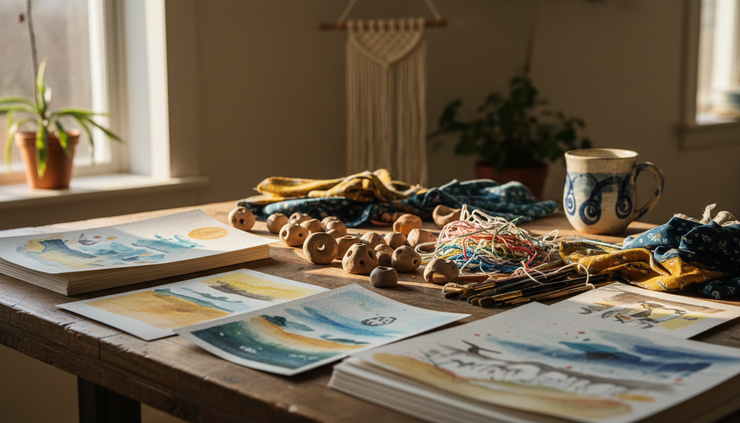
Future posts may show a table covered in materials, a half-finished series, a failed test that led to a better idea, or the quiet work of preparing pieces for sale. I may write about choosing paper, mixing colors, working through a composition problem, or deciding when a piece is done.
Some days, the most interesting part of the work is not the final image. It is the decision that changed everything.
For example, a piece may feel too busy until one element is removed. A color may seem wrong until it appears next to another color. A rough edge may become the part that gives the work life. These are the kinds of details I want to notice and share.
I also want to write about the practical side of keeping a creative practice going. That might include organizing supplies, setting manageable goals, balancing event preparation with open-ended studio time, and returning to work after a slow season.
Creative practice is built through repetition. Some days bring clear progress. Other days are for cleaning brushes, sorting scraps, updating inventory, or making one small decision that keeps the work moving.
Those days count too.
How this space will grow over time
Because this is a future home for my work, I expect the blog to grow in layers. Early posts may be simple updates and studio notes. Over time, it may become a fuller archive of shows, fairs, workshops, experiments, finished pieces, and lessons learned.
I like the idea of a blog as a living record. Social posts move quickly and disappear down a feed. A blog gives an idea more room. It lets an event have context. It lets a piece have a backstory. It lets a workshop be remembered beyond the day it happened.
This site can become a place to find:
Upcoming event details
Recaps from art shows and crafts fairs
Workshop notes and project previews
Studio experiments and material tests
Reflections on my art process
New work as it develops
It can also help me see patterns in my own practice. When I write things down, I notice what keeps returning. Certain colors, questions, materials, and themes begin to stand out. That record can guide future work in a quiet but meaningful way.

A place to return to
This blog will be part event calendar, part studio journal, and part invitation. It will hold the public moments, like art shows, crafts fairs, and workshops, alongside the quieter work of sketching, testing, making, changing, and finishing.
My hope is that it becomes a place where finished art feels connected to the hands-on process behind it. A place where upcoming events are easy to find. A place where someone can read about a workshop and feel welcome to try. A place where the story of the work has room to breathe.
There will be polished pieces here, but there will also be process notes, questions, experiments, and lessons from the table, booth, and classroom. That feels right to me.
The next step is to keep making, keep showing up, and keep recording the path as it unfolds.

Comments